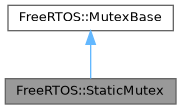
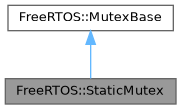
Class that encapsulates the functionality of a FreeRTOS mutex. More...
#include <FreeRTOS/Mutex.hpp>
Public Member Functions | |
| StaticMutex () | |
Construct a new StaticMutex object by calling SemaphoreHandle_t xSemaphoreCreateMutexStatic( StaticSemaphore_t
*pxMutexBuffer ) | |
| StaticMutex (const StaticMutex &)=delete | |
| StaticMutex & | operator= (const StaticMutex &)=delete |
| StaticMutex (StaticMutex &&) noexcept=default | |
| StaticMutex & | operator= (StaticMutex &&) noexcept=default |
 Public Member Functions inherited from FreeRTOS::MutexBase Public Member Functions inherited from FreeRTOS::MutexBase | |
| MutexBase (const MutexBase &)=delete | |
| MutexBase & | operator= (const MutexBase &)=delete |
| bool | isValid () const |
| Function that checks if the underlying semaphore handle is not NULL. This should be used to ensure a semaphore has been created correctly. | |
| bool | lock (const TickType_t ticksToWait=portMAX_DELAY) const |
Function that calls xSemaphoreTake( SemaphoreHandle_t
xSemaphore, TickType_t xTicksToWait ) | |
| bool | lockFromISR (bool &higherPriorityTaskWoken) const |
Function that calls xSemaphoreTakeFromISR ( SemaphoreHandle_t xSemaphore, signed BaseType_t *pxHigherPriorityTaskWoken ) | |
| bool | lockFromISR () const |
Function that calls xSemaphoreTakeFromISR ( SemaphoreHandle_t xSemaphore, signed BaseType_t *pxHigherPriorityTaskWoken ) | |
| bool | unlock () const |
Function that calls xSemaphoreGive( SemaphoreHandle_t xSemaphore
) | |
Private Attributes | |
| StaticSemaphore_t | staticMutex |
Additional Inherited Members | |
| Static Public Member Functions inherited from FreeRTOS::MutexBase | |
| static void * | operator new (size_t)=delete |
| static void * | operator new[] (size_t)=delete |
| static void * | operator new (size_t, void *ptr) |
| static void * | operator new[] (size_t, void *ptr) |
Detailed Description
Class that encapsulates the functionality of a FreeRTOS mutex.
Each mutex require a small amount of RAM that is used to hold the mutex's state. If a mutex is created using FreeRTOS::Mutex then the required RAM is automatically allocated from the FreeRTOS heap. If a mutex is created using FreeRTOS::StaticMutex then the RAM is provided by the application writer and allows the RAM to be statically allocated at compile time. See the Static Vs Dynamic allocation page for more information.
Mutexes and binary semaphores are very similar but have some subtle differences: Mutexes include a priority inheritance mechanism, binary semaphores do not. This makes binary semaphores the better choice for implementing synchronisation (between tasks or between tasks and an interrupt), and mutexes the better choice for implementing simple mutual exclusion.
The priority of a task that locks a mutex will be temporarily raised if another task of higher priority attempts to obtain the same mutex. The task that owns the mutex 'inherits' the priority of the task attempting to lock the same mutex. This means the mutex must always be unlocked back otherwise the higher priority task will never be able to lock the mutex, and the lower priority task will never 'disinherit' the priority.
Constructor & Destructor Documentation
◆ StaticMutex()
|
inline |
Construct a new StaticMutex object by calling SemaphoreHandle_t xSemaphoreCreateMutexStatic( StaticSemaphore_t
*pxMutexBuffer )
- Warning
- This class contains the storage buffer for the mutex, so the user should create this object as a global object or with the static storage specifier so that the object instance is not on the stack.
Example Usage
The documentation for this class was generated from the following file:
- /home/runner/work/FreeRTOS-Cpp/FreeRTOS-Cpp/FreeRTOS-Cpp/include/FreeRTOS/Mutex.hpp