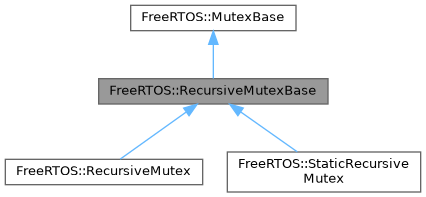
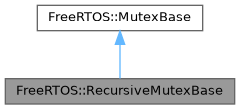
Base class that provides the recursive mutex interface to FreeRTOS::RecursiveMutex and FreeRTOS::StaticRecursiveMutex. This class exists to override the lock() and unlock() functions which require different underlying functions from what is used in FreeRTOS::MutexBase. More...
#include <FreeRTOS/Mutex.hpp>
Public Member Functions | |
| RecursiveMutexBase (const RecursiveMutexBase &)=delete | |
| RecursiveMutexBase & | operator= (const RecursiveMutexBase &)=delete |
| bool | lock (const TickType_t ticksToWait=portMAX_DELAY) const |
Function that calls xSemaphoreTakeRecursive( SemaphoreHandle_t
xMutex, TickType_t xTicksToWait ) | |
| bool | unlock () const |
Function that calls xSemaphoreGiveRecursive( SemaphoreHandle_t
xSemaphore ) | |
 Public Member Functions inherited from FreeRTOS::MutexBase Public Member Functions inherited from FreeRTOS::MutexBase | |
| MutexBase (const MutexBase &)=delete | |
| MutexBase & | operator= (const MutexBase &)=delete |
| bool | isValid () const |
| Function that checks if the underlying semaphore handle is not NULL. This should be used to ensure a semaphore has been created correctly. | |
| bool | lock (const TickType_t ticksToWait=portMAX_DELAY) const |
Function that calls xSemaphoreTake( SemaphoreHandle_t
xSemaphore, TickType_t xTicksToWait ) | |
| bool | lockFromISR (bool &higherPriorityTaskWoken) const |
Function that calls xSemaphoreTakeFromISR ( SemaphoreHandle_t xSemaphore, signed BaseType_t *pxHigherPriorityTaskWoken ) | |
| bool | lockFromISR () const |
Function that calls xSemaphoreTakeFromISR ( SemaphoreHandle_t xSemaphore, signed BaseType_t *pxHigherPriorityTaskWoken ) | |
| bool | unlock () const |
Function that calls xSemaphoreGive( SemaphoreHandle_t xSemaphore
) | |
Static Public Member Functions | |
| static void * | operator new (size_t, void *) |
| static void * | operator new[] (size_t, void *) |
| static void * | operator new (size_t)=delete |
| static void * | operator new[] (size_t)=delete |
| Static Public Member Functions inherited from FreeRTOS::MutexBase | |
| static void * | operator new (size_t)=delete |
| static void * | operator new[] (size_t)=delete |
| static void * | operator new (size_t, void *ptr) |
| static void * | operator new[] (size_t, void *ptr) |
Private Member Functions | |
| RecursiveMutexBase (RecursiveMutexBase &&) noexcept=default | |
| RecursiveMutexBase & | operator= (RecursiveMutexBase &&) noexcept=default |
Friends | |
| class | RecursiveMutex |
| class | StaticRecursiveMutex |
Detailed Description
Base class that provides the recursive mutex interface to FreeRTOS::RecursiveMutex and FreeRTOS::StaticRecursiveMutex. This class exists to override the lock() and unlock() functions which require different underlying functions from what is used in FreeRTOS::MutexBase.
- Note
- This class is not intended to be instantiated by the user. Use FreeRTOS::RecursiveMutex or FreeRTOS::StaticRecursiveMutex.
Member Function Documentation
◆ lock()
|
inline |
Function that calls xSemaphoreTakeRecursive( SemaphoreHandle_t
xMutex, TickType_t xTicksToWait )
- Parameters
-
ticksToWait The time in ticks to wait for the mutex to become available. The macro portTICK_PERIOD_MS can be used to convert this to a real time. A block time of zero can be used to poll the mutex. If the task already owns the mutex then take() will return immediately no matter what the value of ticksToWait.
- Return values
-
true If the mutex was locked. false If ticksToWait expired without the mutex becoming available.
Example Usage
◆ unlock()
|
inline |
Function that calls xSemaphoreGiveRecursive( SemaphoreHandle_t
xSemaphore )
A mutex used recursively can be locked repeatedly by the owner. The mutex doesn't become available again until the owner has called unlock() for each successful lock request. For example, if a task successfully locks the same mutex 5 times then the mutex will not be available to any other task until it has also unlocked the mutex back exactly five times.
- Returns
- true If the mutex was unlocked.
- false Otherwise.
Example Usage
The documentation for this class was generated from the following file:
- /home/runner/work/FreeRTOS-Cpp/FreeRTOS-Cpp/FreeRTOS-Cpp/include/FreeRTOS/Mutex.hpp